LiDAR vs Camera: Full Comparison for Robots and Vehicles
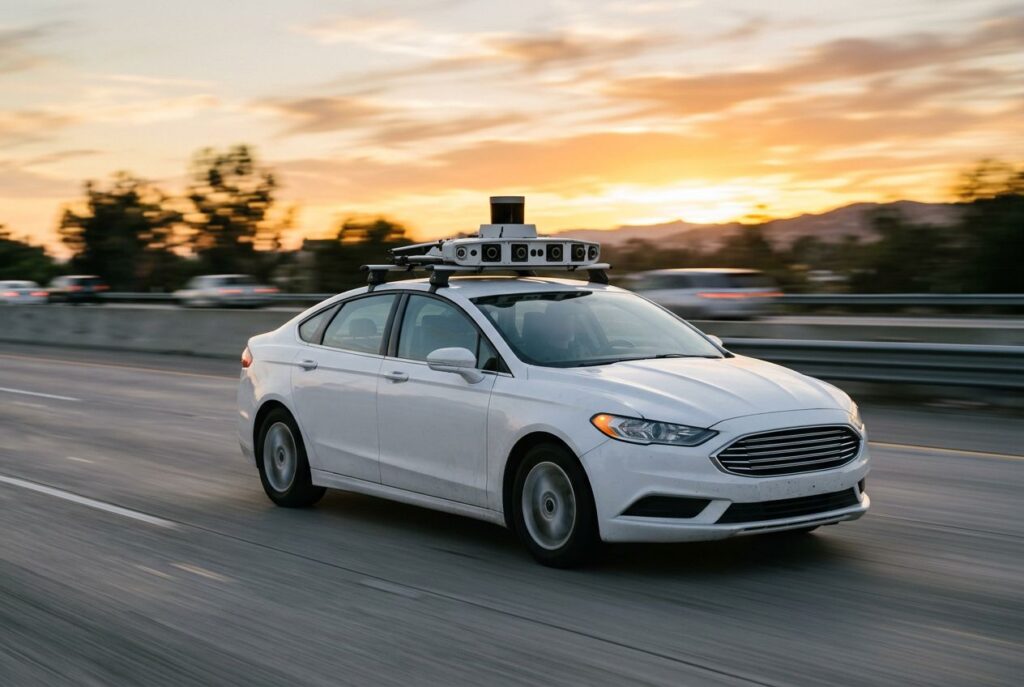
LiDAR builds a 3D point cloud by timing laser pulses, so it measures distance directly; a camera captures light intensity and color, so a computer has to infer distance from what it sees. That single difference explains almost every trade-off between them: LiDAR is more accurate at raw depth and keeps working in the dark, while cameras are cheaper, lighter, and understand what an object actually is. This guide compares how each sensor measures the world, walks through visual SLAM versus LiDAR SLAM for robot mapping, and shows why most production systems — from robot vacuums to robotaxis — end up using both.
How LiDAR measures the world
LiDAR (Light Detection and Ranging) is an active sensor: it emits its own near-infrared laser pulses and times how long each one takes to bounce off a surface and return. Because the speed of light is constant, that round-trip time converts directly into a distance measurement. Sweep that measurement across a scene — with a spinning mechanism, a MEMS mirror, or a solid-state optical array — and the sensor builds a point cloud: a set of X, Y, Z coordinates that describes the geometry of everything in range, without needing to know what any of it is.
Because it generates its own light, LiDAR works identically in daylight and total darkness. Its main weakness is also physical: the same wavelength that gives it precision also scatters off rain, fog, snow, and dust, which shortens effective range and adds noise in bad weather. Historically, LiDAR was also the most expensive sensor on a robot or vehicle, though solid-state designs have pushed automotive-grade units well below where they used to sit.
How cameras see — and how they estimate depth
A standard camera is a passive sensor: it captures whatever light is already in the scene and turns it into a 2D grid of color values. A single camera has no native sense of distance — a photo of a toy car and a photo of a real car can look identical in size and shape. Getting depth out of a camera takes one of three approaches:
- Monocular depth estimation: a neural network guesses depth from a single image using learned cues like size, occlusion, and perspective. It is cheap and lightweight but scale-ambiguous — the network cannot tell absolute distance without another reference, only relative depth.
- Stereo vision: two lenses at a fixed, known distance apart (the baseline) capture the same scene from slightly different angles. Matching the same point across both images and measuring its pixel shift (disparity) gives true metric depth through triangulation — the same principle as human binocular vision. Accuracy depends on the baseline and falls off with distance.
- RGB-D (depth) cameras: a camera module that adds its own active depth sensor — either a stereo pair with an IR pattern projector to help matching in low-texture scenes, or a time-of-flight sensor that measures light travel time per pixel. These output a color image and a per-pixel depth map together, without any external computation.
The Intel RealSense D435i is a widely used example of the stereo-plus-IMU category: it pairs a stereo depth module (up to 1280×720 depth resolution, up to 90 fps, roughly 87°×58° field of view, ideal working range of about 0.3–3 m) with a built-in IMU for six-degrees-of-freedom motion data, which is exactly what a robot needs to track its own movement between frames.
Disclosure: this article contains affiliate links. If you buy through them we may earn a small commission at no extra cost to you.

- the intel realsense d435i includes:
- a bmi055 inertial measurement unit.
- the intel realsense sdk 2. 0 which provides a depth and imu data stream.
- imu data that is time stamped to align with depth data as needed.
- desktop tripod. usb-c cable.
At the other end of the design space, boards like the Luxonis OAK-D pair a stereo depth pair with a Myriad X vision processing unit that runs neural-network inference directly on the camera, so object detection and depth fusion happen on-device instead of on the host computer's CPU.

- OAK-D is the ultimate camera for robotic vision that perceives the world like a human by combining stereo depth camera and high-resolution color camera with an on-device Neural Network inferencing and Computer Vision capabilities. It uses USB-C for both power and USB3 connectivity.
LiDAR vs camera: side-by-side comparison
Neither sensor is strictly better — they fail in different ways and excel at different things:
| Criterion | LiDAR | Camera (mono / stereo / RGB-D) |
|---|---|---|
| How it senses depth | Direct: time-of-flight of emitted laser light | Inferred: triangulation (stereo), active pattern/ToF (RGB-D), or learned cues (mono) |
| Output | Metric 3D point cloud, no color or texture | Color image, optionally with a depth map |
| Works in darkness | Yes — it supplies its own light | Passive mono/stereo need ambient or added light; active RGB-D units add their own IR illuminator |
| Weather robustness | Degraded by heavy rain, fog, snow, and dust | Degraded by glare, fog, and low visibility; unaffected by radio interference |
| Semantic understanding | None on its own — geometry only | Strong — color and texture feed directly into object classification |
| Typical cost and weight | Higher, though solid-state automotive units have fallen sharply | Low-cost and lightweight, easy to add several to one platform |
| Compute load | Point-cloud processing (filtering, registration) | Often heavier: depth estimation or feature matching runs continuously per frame |
Visual SLAM vs LiDAR SLAM
SLAM (simultaneous localization and mapping) is the problem of building a map of an unknown space while simultaneously tracking a robot's position inside it — and it is where the choice between LiDAR and cameras matters most for mobile robots.
LiDAR SLAM matches successive point clouds against each other (a process often built on iterative closest point, or ICP-style scan matching) to estimate how far the robot moved between scans, then stitches the aligned scans into a growing map. Because it works directly on precise geometry, it is reliable in the dark, in textureless corridors, and in industrial environments with repetitive-looking walls — situations that defeat camera-based methods. The 2D LiDAR case, where the sensor sweeps a single horizontal plane, is computationally light and is the default choice for warehouse and floor-cleaning robots that just need to avoid obstacles and not re-visit the same spot.
Visual SLAM (VSLAM) tracks distinctive visual features (corners, edges, textured patches) across a stream of camera frames and triangulates their 3D position as the camera moves, building a sparse or dense map from those tracked points. Monocular VSLAM has a structural weakness: from images alone, the system cannot recover absolute scale — it doesn't know whether it is looking at a small object up close or a large one far away — which is why almost every practical VSLAM system fuses in IMU data (accelerometer and gyroscope readings) to anchor scale and survive the brief moments when the camera loses track of visual features; that combination is usually called visual-inertial odometry (VIO). Stereo and RGB-D VSLAM sidestep the scale problem because depth is measured directly, at the cost of the extra hardware.
VSLAM's weak points are the mirror image of LiDAR SLAM's strengths: featureless surfaces (blank walls, glass, uniform floors), low light, and fast motion that blurs the image all degrade tracking quality. Its advantages are weight, power draw, and cost — a camera and IMU are a fraction of the mass and price of a spinning or solid-state LiDAR unit, which matters enormously on a drone or a small mobile robot running on a battery.
Choosing the right sensor for your project
In practice, the choice tracks the constraints of the platform more than a single "better" sensor:
- Self-driving cars: the most safety-critical deployments still lean on redundancy across sensor types rather than picking one. Waymo's current-generation Waymo Driver, for example, combines 13 cameras, 4 lidar units, and 6 radar units so that camera, lidar, and radar cover for each other's blind spots and weather weaknesses.
- Indoor and warehouse robots: 2D LiDAR SLAM remains common because the environment is often dim, geometrically simple, and safety-focused — a mapping failure means a collision, not just a bad photo.
- Drones and small mobile robots: visual-inertial VSLAM dominates where payload and power budgets are tight, since a camera and IMU weigh a fraction of a LiDAR unit.
- Mixed reality and mobile scanning: Apple has built a LiDAR Scanner into the rear camera system of current iPhone Pro and iPhone Air models specifically to give AR apps and room-scanning tools fast, accurate depth without relying on stereo triangulation from a single handheld device.
If you're building your own rig rather than buying a finished platform, current bestselling stereo depth cameras are a reasonable starting point for comparing what's actually available before you commit to a sensor:

- Lab-Grade Indoor Accuracy, ±3mm at 1m – Achieve sub-millimeter precision with structured light technology. Perfect for 3D modeling, VR AR gesture recognition, and AI vision tasks. Zero blind spot measurements in controlled lab, warehouse, or industrial settings. long-range (8m) for logistics or high-res RGB (1280x720) for enhanced visual data. 3d camera outputs include point clouds, depth maps, IR, and RGB.
- High-Efficiency Processing for Real-Time Robotics – Powered by Orbbec ASIC, Astra Pro robot camera delivers artifact-free, high-fidelity depth at 1280×1024 @ 7 fps and RGB at 1280×720 @ 30 fps simultaneously. With a 0.6–8m ranges, optimization excels in lag-free applications like SLAM, automation, obstacle avoidance, and pose estimation—positioning Astra Pro as the premier camera for indoor robotic control where every millisecond counts.
- Seamless Multi-Camera Sync for Scalable Systems – Synchronize up to 30 sensors at 30 fps with zero frame drops — enabling true 360° environment scanning, large-scale motion tracking, and sub-millisecond multi-robot coordination. In multi-agent robotics, perfect timing of robot parts isn’t a feature… it’s the decisive advantagefor robotics developers.
- Ultra-Low Power & Portable – Battery life can make or break mobile robotics. Power draw <3W and weight as low as 310g—battery-friendly for AMR, AGV, drones, mobile platforms, and field research setups. Compact size enables integration into embedded systems and wearable devices, streamlining development for on-the-go perception in research prototypes or field-deployable bots.
- Plug-and-Play Integration for Fast Prototyping – USB 2.0 single-cable connection (power + data), direct drop-in replacement for legacy systems. The camera works with Windows, Linux, and Android operating systems. The camera is compatible with OpenNI SDK, Astra SDK, ROS1/ ROS2, enabling fast integration into mobile robots, industrial PCs, embedded platforms, and AI vision applications
- Professional technical support is provided for SDK configuration, ROS integration, driver installation and project debugging. If you encounter operational issues or technical confusion during development with this Astra Pro 3D Depth Camera, feel free to contact us for detailed guidance.

- 📷 Dual IMX219 Stereo Camera Module: IMX219-83 Stereo Camera adopts dual 8MP IMX219 sensors, designed as a binocular camera module for stereo vision, depth vision, AI vision and embedded imaging projects.
- 👁️ Binocular Camera for Depth Vision: This dual camera module supports stereo vision and depth vision applications, making it suitable for robotics, visual recognition, 3D perception, machine vision and AI development.
- 🔌 Compatible with Raspberry Pi and Jetson Boards: The IMX219 stereo camera module supports for Raspberry Pi 5 and CM3/CM3+/CM4 base boards, as well as Jetson Nano, Xavier NX, Orin NX, Orin Nano and RDK series boards.
- 🧩 Compact Camera Module for Embedded Projects: The binocular camera module is suitable for compact AI vision systems, robot vision, edge computing, image capture experiments and embedded development applications.
- ⚙️ Dual 8MP Camera for AI Vision Development: With two onboard 8-megapixel camera sensors, this IMX219-83 camera module helps developers build stereo imaging, depth estimation and visual data collection projects.

- 1080p·60fps FHD USB 3D Camera Module: The 1080P Full HD usb camera module and 1/2.7" CMOS sensor features a resolution of up to 3840*1080, shows every detail clearly and delivers crisp and realistic video. It also offers high frame rate video recording at 60fps. Live broadcasting and streaming distribution are possible without delay or distortion.
- Synchronous Dual Lens: This camera module has two lenses so you can get two synchronised HD images. It is suitable for indoor face detection and live detection. Functions such as face template capture and face comparison can be realised.
- 115° Wide Angle View: No distortion lens, restore the real image and color. The HFOV is approximately 115°, which gives you a wide field of view. You can see more of the scene and more details on the screen, which makes detection and other tasks more convenient.
- Plug & Play: This usb camera module simply connects to the monitor via usb cable and runs the software. Just plug and play, no additional drivers required, ready to use the camera module in applications such as Zoom, Skype, Youtube, Microsoft Teams, Facetime, Facebook and more. The usb camera module for laptop is also compatible with Windows XP/7/8/10/11, Linux, Android, Mac OS and etc.
- Wide Applications: The usb camera can be used for high standard medical and industrial requirements and machine vision. Wide application for 3D scanner, VR camera, electronic microscope, automatic image acquisition system, medical diagnostic image acquisition, HD surveillance, etc.
Pair a depth camera with a Raspberry Pi or an NVIDIA Jetson Orin Nano for the compute headroom that real-time VSLAM needs, and see our Raspberry Pi AI Camera setup guide if you're starting from a Pi-based camera rig instead of a dedicated depth module.
Why serious systems fuse LiDAR and cameras anyway
The comparison above makes the case for fusion rather than a winner: LiDAR contributes precise, direct geometry that works in the dark and doesn't care about the weather (within limits); cameras contribute the color, texture, and semantic context — "that's a stop sign," not just "there's a flat vertical surface 40 m ahead" — that geometry alone can't provide. Combined through sensor fusion algorithms such as Kalman filtering or learned fusion networks, the two streams cross-validate each other: a false detection in one modality can be vetoed by the others, and if one sensor is temporarily degraded — a camera blinded by glare, a LiDAR scattered by fog — the system still has a usable estimate of the world. That is also the logic behind fusing a third sensor type where weather resistance matters most, which we cover in our LiDAR vs radar comparison. For the full picture of how these streams get combined into one coherent model, start with our complete guide to sensor fusion.
Frequently asked questions about LiDAR vs camera
Is LiDAR better than a camera?
Not universally. LiDAR is more accurate for raw depth and geometry and works identically in the dark; cameras are cheaper, lighter, and far better at understanding what an object is rather than just where it is. Most serious systems use both rather than choosing one.
What are the main disadvantages of LiDAR?
LiDAR performance degrades in heavy rain, fog, snow, and dust because those particles scatter the laser light it depends on. It also produces no color or texture information on its own, and historically it has cost and weighed more than a camera, though solid-state designs have narrowed that gap.
Why doesn't Tesla use LiDAR while other automakers do?
Tesla's public position is that cameras combined with neural networks can achieve full self-driving without LiDAR, treating vision as sufficient on its own. Waymo and most robotaxi operators instead prioritize sensor redundancy, adding LiDAR and radar alongside cameras so that a weakness in one sensor type doesn't become a single point of failure.
Does the iPhone camera use LiDAR?
Current iPhone Pro and iPhone Air models include a LiDAR Scanner as part of the rear camera system, used for depth data in AR apps and room-scanning tools. Standard and Plus iPhone models do not have it.
Does Waymo use LiDAR, cameras, or both?
Both, plus radar. Waymo's current-generation Waymo Driver combines 13 cameras, 4 lidar units, and 6 radar units so the three sensor types provide overlapping coverage and back each other up in different weather and lighting conditions.
Is LiDAR or a camera better for a robot vacuum?
It's a trade-off between mapping reliability and cost rather than a clear winner. LiDAR-equipped robot vacuums build maps using direct distance measurements and keep working in the dark, while camera-based (VSLAM) models are usually cheaper but can struggle to map dim rooms or plain, featureless floors and walls.
Last update 2026-10-01. Price and product availability may change.
Recommended: