Stereo Camera Explained: How It Works and What to Buy
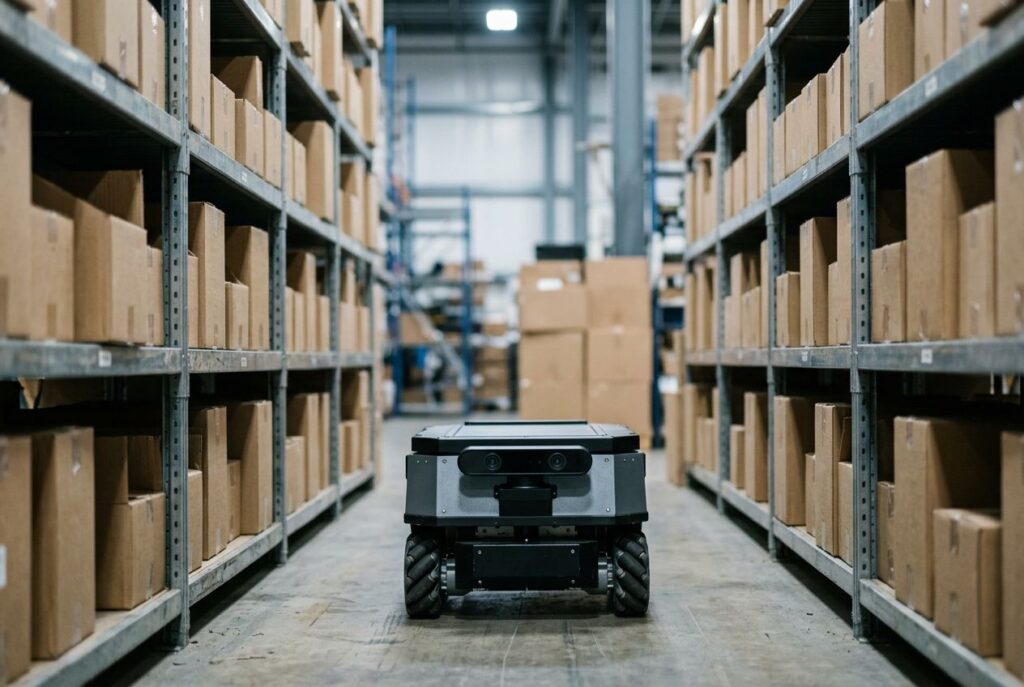
A stereo camera measures depth by comparing what two lenses, spaced a known distance apart, each see of the same scene — the same trick your two eyes use to judge how far away something is. By finding matching points in the left and right images and measuring how far each one shifts between the two views (the disparity), a processor turns that shift into a distance value for every pixel, producing a depth map or a full 3D point cloud in real time. This guide covers how that math works, how passive stereo compares to active stereo, time-of-flight, and structured light, where these cameras actually show up in robots, drones, and edge-AI projects, and what to check in a datasheet before buying one.
How a stereo camera computes depth
A stereo camera pairs two image sensors, separated by a fixed distance called the baseline, and captures the scene from both viewpoints at the same instant. For any object visible in both images, its position shifts horizontally between the left and right frame — a shift called disparity. Objects close to the camera shift a lot between the two views; distant objects barely move at all, and that relationship is inversely proportional: disparity falls off as distance increases, scaled by the baseline and the lens's focal length. A processor that finds enough matching points between the two images can convert every disparity value into a depth value and build a full depth map, or project it into a 3D point cloud.
Two processing steps make reliable matching possible. Calibration characterizes each lens's distortion and the precise geometric relationship between the two sensors. Rectification then warps both images so that matching points fall on the same horizontal line, turning the search for correspondences into a simpler one-dimensional problem instead of a two-dimensional one. Only after rectification does the stereo-matching algorithm scan each row for the best pixel match and output the disparity map — which can then be scaled into real-world depth using the camera's calibrated projective parameters.
Passive stereo vs. active stereo
What's described above is passive stereo: it relies entirely on ambient light and on the scene having enough visual texture for the matching algorithm to find corresponding points. A blank wall, a sheet of glass, or a dim room can starve a passive stereo system of the detail it needs, and depth quality degrades or fails outright.
Active stereo addresses that by projecting a pattern — usually infrared, so it stays invisible to people — onto the scene. The projected dots or lines add artificial texture that the two cameras can match reliably even on featureless surfaces, at some cost in outdoor performance, since strong sunlight can wash out the projected pattern. Several current stereo cameras built for robotics combine both approaches: a passive stereo pair for normal conditions, enhanced with an infrared projector for texture-poor scenes.
Stereo vs. time-of-flight vs. structured light
Stereo isn't the only way to build a depth map. Two other approaches show up constantly in the same product category:
- Time-of-flight (ToF): a single emitter fires light and a sensor measures how long it takes to return, giving distance directly per pixel without a second camera or a matching algorithm. It's simpler in software but has its own range and multipath limitations, covered in detail in our time-of-flight sensor guide.
- Structured light: a projector casts a known pattern onto the scene, and a single camera measures how that pattern deforms to infer depth. Apple's TrueDepth camera system, which powers Face ID, works this way — it projects and analyzes thousands of infrared dots to build a depth map of the user's face rather than comparing two camera views.
Compared with laser-based LiDAR ranging, stereo, time-of-flight, and structured light are all camera-based approaches: they output dense depth over an image frame rather than a sparse set of laser returns, which is a big part of why they dominate short-to-medium-range robotics and consumer devices, while LiDAR keeps the edge at long range and in direct sunlight.
Where stereo cameras actually show up
Robotics and autonomous machines
Mobile robots, robotic arms, and warehouse automation are the biggest market for stereo cameras: onboard depth lets an arm judge where to grip an object, or a mobile robot avoid an obstacle, without a full LiDAR unit. These systems are often paired with a compact edge-AI board — an NVIDIA Jetson Orin Nano, say — to run perception alongside the camera's own depth output. The Luxonis OAK-D family is a common reference point: a 75 mm baseline between its two global-shutter mono sensors, stereo matching run on its own onboard vision processor (4 TOPS, 1.4 TOPS for AI) instead of the host CPU, a usable depth range from roughly 0.7–0.8 m to about 12 m depending on resolution, and a 9-axis IMU in the same housing.
Disclosure: this article contains affiliate links. If you buy through them we may earn a small commission at no extra cost to you.

- OAK-D is the ultimate camera for robotic vision that perceives the world like a human by combining stereo depth camera and high-resolution color camera with an on-device Neural Network inferencing and Computer Vision capabilities. It uses USB-C for both power and USB3 connectivity.
Logistics and digital twins
Outdoor-rated units also mount on forklifts, AMRs, and fixed warehouse infrastructure, feeding 3D data into digital-twin software for pallet monitoring and parcel dimensioning — use cases Stereolabs lists directly for its outdoor-rated ZED 2i.
Drones and aerial platforms
Tight weight and power budgets favor small, low-power stereo modules for close-range obstacle avoidance during takeoff, landing, and low-altitude flight, complementing longer-range sensors for the rest of the flight.
AR, VR, and phones
A short-baseline stereo camera on a headset tracks hands and nearby surfaces at close range without adding bulk — the role Stereolabs' compact ZED Mini is built for. On phones, dual cameras have done portrait-mode blur for years, but true stereoscopic capture arrived more recently: Apple announced the iPhone 15 Pro in 2023 as its first iOS device able to record actual left/right 3D photo and video pairs.
DIY, research, and education
Since the math is well documented and the hardware is cheap, stereo vision is a common way to build computer-vision skills rather than only read about them. Dual-lens boards for the Raspberry Pi's camera connector let hobbyists capture synced stereo pairs and try disparity and calibration themselves — see our guide to Raspberry Pi AI kits for the accelerator side.

- 📷 Dual IMX219 Stereo Camera Module: IMX219-83 Stereo Camera adopts dual 8MP IMX219 sensors, designed as a binocular camera module for stereo vision, depth vision, AI vision and embedded imaging projects.
- 👁️ Binocular Camera for Depth Vision: This dual camera module supports stereo vision and depth vision applications, making it suitable for robotics, visual recognition, 3D perception, machine vision and AI development.
- 🔌 Compatible with Raspberry Pi and Jetson Boards: The IMX219 stereo camera module supports for Raspberry Pi 5 and CM3/CM3+/CM4 base boards, as well as Jetson Nano, Xavier NX, Orin NX, Orin Nano and RDK series boards.
- 🧩 Compact Camera Module for Embedded Projects: The binocular camera module is suitable for compact AI vision systems, robot vision, edge computing, image capture experiments and embedded development applications.
- ⚙️ Dual 8MP Camera for AI Vision Development: With two onboard 8-megapixel camera sensors, this IMX219-83 camera module helps developers build stereo imaging, depth estimation and visual data collection projects.
What to check before buying a stereo camera
Baseline
The distance between the two lenses sets the trade-off between close-range precision and far-range reach. A short baseline of a few centimeters gives accurate close-up depth but loses accuracy quickly at range; a longer baseline extends useful range but needs more physical space and struggles at very short distances, since the two views only converge past a minimum working distance. Datasheets list this figure explicitly, and it's the single number that tells you the most about what a given camera is built for.
Onboard processing vs. host processing
Some stereo cameras compute the disparity map on the device itself, using a dedicated vision processor, so the host only receives a finished depth image. Others stream raw stereo frames over USB and leave the depth computation — often GPU-accelerated — to software running on the connected computer. Neither approach is strictly better: onboard processing keeps the interface bandwidth low and works with a modest host, while host-side processing can apply heavier, more accurate algorithms if the host has the compute to spare.
Resolution, shutter type, and sync
A global shutter, which captures an entire frame at the same instant, avoids the motion distortion that a rolling shutter introduces on fast-moving scenes — important for anything mounted on a moving robot or vehicle. The two sensors also need to be triggered in hardware sync; software-only synchronization introduces timing error that shows up as bad disparity at object edges.
Interface and built-in IMU
Stereo cameras aimed at embedded and Raspberry Pi projects typically connect over the board's camera (CSI/MIPI) connector, while robotics-grade units use USB 3 for bandwidth. Many also bundle an inertial measurement unit next to the lenses, so software can fuse visual depth with acceleration and rotation data for more stable pose estimates — the same idea behind sensor fusion generally, and something we cover in detail in our guide to IMU sensors.
Environmental rating
A camera meant to sit on a warehouse robot or an outdoor drone needs a sealed enclosure — commonly rated to an IP standard against dust and water — while an indoor development board doesn't need that protection at all. Check the rating before assuming a camera built for a lab bench will survive a loading dock.
Popular stereo camera families compared
These are device families frequently cited in robotics and computer-vision projects, compared on specification rather than price:
| Model family | Baseline | Interface | Notable extras | Manufacturer-stated depth range |
|---|---|---|---|---|
| Luxonis OAK-D | 75 mm | USB (2/3, up to 10 Gbps) | Onboard vision processor (4 TOPS), 9-axis IMU | ~0.7–0.8 m to ~12 m |
| Stereolabs ZED 2i | 120 mm | USB 3.1 Type-C | IMU, barometer, magnetometer; IP66-rated enclosure | 0.2–20 m |
| Stereolabs ZED Mini | 63 mm | USB 3.1 | Compact form factor for headset/VR mounting | Short range, indoor-oriented |
| RealSense D400 series (spun off from Intel in 2025; Cognex agreed to acquire it in September 2026, closing expected in Q4 2026) | Varies by model | USB | Passive stereo enhanced with an infrared projector; onboard depth processing | Varies by model |
Beyond these named families, the market also includes plenty of inexpensive dual-lens USB webcam modules built around the same stereo principle — aimed at makers and students prototyping their own stereo-matching code rather than deploying a packaged robotics platform. Current options in that category include:

- Lab-Grade Indoor Accuracy, ±3mm at 1m – Achieve sub-millimeter precision with structured light technology. Perfect for 3D modeling, VR AR gesture recognition, and AI vision tasks. Zero blind spot measurements in controlled lab, warehouse, or industrial settings. long-range (8m) for logistics or high-res RGB (1280x720) for enhanced visual data. 3d camera outputs include point clouds, depth maps, IR, and RGB.
- High-Efficiency Processing for Real-Time Robotics – Powered by Orbbec ASIC, Astra Pro robot camera delivers artifact-free, high-fidelity depth at 1280×1024 @ 7 fps and RGB at 1280×720 @ 30 fps simultaneously. With a 0.6–8m ranges, optimization excels in lag-free applications like SLAM, automation, obstacle avoidance, and pose estimation—positioning Astra Pro as the premier camera for indoor robotic control where every millisecond counts.
- Seamless Multi-Camera Sync for Scalable Systems – Synchronize up to 30 sensors at 30 fps with zero frame drops — enabling true 360° environment scanning, large-scale motion tracking, and sub-millisecond multi-robot coordination. In multi-agent robotics, perfect timing of robot parts isn’t a feature… it’s the decisive advantagefor robotics developers.
- Ultra-Low Power & Portable – Battery life can make or break mobile robotics. Power draw <3W and weight as low as 310g—battery-friendly for AMR, AGV, drones, mobile platforms, and field research setups. Compact size enables integration into embedded systems and wearable devices, streamlining development for on-the-go perception in research prototypes or field-deployable bots.
- Plug-and-Play Integration for Fast Prototyping – USB 2.0 single-cable connection (power + data), direct drop-in replacement for legacy systems. The camera works with Windows, Linux, and Android operating systems. The camera is compatible with OpenNI SDK, Astra SDK, ROS1/ ROS2, enabling fast integration into mobile robots, industrial PCs, embedded platforms, and AI vision applications
- Professional technical support is provided for SDK configuration, ROS integration, driver installation and project debugging. If you encounter operational issues or technical confusion during development with this Astra Pro 3D Depth Camera, feel free to contact us for detailed guidance.
- 📷 Dual IMX219 Stereo Camera Module: IMX219-83 Stereo Camera adopts dual 8MP IMX219 sensors, designed as a binocular camera module for stereo vision, depth vision, AI vision and embedded imaging projects.
- 👁️ Binocular Camera for Depth Vision: This dual camera module supports stereo vision and depth vision applications, making it suitable for robotics, visual recognition, 3D perception, machine vision and AI development.
- 🔌 Compatible with Raspberry Pi and Jetson Boards: The IMX219 stereo camera module supports for Raspberry Pi 5 and CM3/CM3+/CM4 base boards, as well as Jetson Nano, Xavier NX, Orin NX, Orin Nano and RDK series boards.
- 🧩 Compact Camera Module for Embedded Projects: The binocular camera module is suitable for compact AI vision systems, robot vision, edge computing, image capture experiments and embedded development applications.
- ⚙️ Dual 8MP Camera for AI Vision Development: With two onboard 8-megapixel camera sensors, this IMX219-83 camera module helps developers build stereo imaging, depth estimation and visual data collection projects.

- 1080p·60fps FHD USB 3D Camera Module: The 1080P Full HD usb camera module and 1/2.7" CMOS sensor features a resolution of up to 3840*1080, shows every detail clearly and delivers crisp and realistic video. It also offers high frame rate video recording at 60fps. Live broadcasting and streaming distribution are possible without delay or distortion.
- Synchronous Dual Lens: This camera module has two lenses so you can get two synchronised HD images. It is suitable for indoor face detection and live detection. Functions such as face template capture and face comparison can be realised.
- 115° Wide Angle View: No distortion lens, restore the real image and color. The HFOV is approximately 115°, which gives you a wide field of view. You can see more of the scene and more details on the screen, which makes detection and other tasks more convenient.
- Plug & Play: This usb camera module simply connects to the monitor via usb cable and runs the software. Just plug and play, no additional drivers required, ready to use the camera module in applications such as Zoom, Skype, Youtube, Microsoft Teams, Facetime, Facebook and more. The usb camera module for laptop is also compatible with Windows XP/7/8/10/11, Linux, Android, Mac OS and etc.
- Wide Applications: The usb camera can be used for high standard medical and industrial requirements and machine vision. Wide application for 3D scanner, VR camera, electronic microscope, automatic image acquisition system, medical diagnostic image acquisition, HD surveillance, etc.
Frequently asked questions about stereo cameras
What is a stereo vision camera?
A stereo vision camera is a camera with two (or more) image sensors positioned a fixed, known distance apart. By comparing the two images, software calculates the disparity between matching points and converts it into a per-pixel depth value, producing a depth map or a 3D point cloud of the scene.
Do humans have stereo vision?
Yes. Human eyes are spaced roughly 6.35 cm apart on average, and the brain compares the slightly different image each eye receives to judge depth — the same intra-ocular distance that early consumer stereo cameras copied as their baseline, before digital models began varying it deliberately for different ranges.
What's the difference between a stereo camera and a depth camera?
"Depth camera" is the broader category: any camera that outputs distance per pixel, regardless of method. A stereo camera is one specific way to build a depth camera, using two lenses and triangulation. Time-of-flight and structured-light cameras are depth cameras too, but they use a single sensor plus an active emitter instead of a matched pair of lenses.
How much does a stereo camera cost?
It spans a wide range depending on the level of integration: basic dual-lens USB modules aimed at makers sit at the low end, mid-range robotics cameras with onboard depth processing and a built-in IMU cost more, and ruggedized outdoor units with sealed enclosures cost more still. Because vendors change pricing and packaging often, check the manufacturer's or retailer's current listing rather than relying on a fixed figure.
What are the best stereoscopic cameras?
There's no single best option — it depends on the job. Robotics builders who want onboard processing in a small form factor tend to look at the Luxonis OAK-D family; teams that need a wide field of view, a sealed enclosure, and a long depth range for outdoor deployments look at Stereolabs' ZED 2i; VR and mixed-reality developers use the shorter-baseline ZED Mini; and makers experimenting with the underlying algorithms often start with an inexpensive dual-lens USB module or a stereo add-on board for a Raspberry Pi.
Can a stereo camera work in low light or on blank surfaces?
Passive stereo struggles with both, because it needs enough ambient light and enough visual texture to match points between the two images reliably. Active stereo cameras address this by projecting an infrared pattern onto the scene to create artificial texture, which is why several robotics-oriented stereo cameras add an infrared projector alongside the two lenses.
For the fundamentals of combining stereo depth with other sensors — IMUs, LiDAR, radar — start with our pillar guide, What is sensor fusion? A complete guide, then see how a built-in IMU adds orientation data in our IMU sensors guide.
Last update 2026-10-03. Price and product availability may change.
Recommended: